| Sakaltutan: Village Map |
|
|
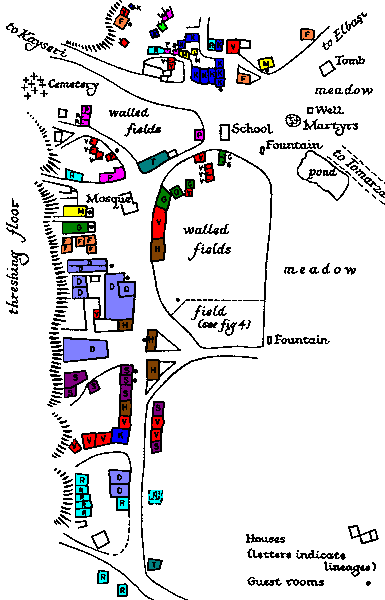
During the period of research, the village of Sakaltutan contained 10 well defined lineages ranging in size from 4 to 20 households and averaging 50 people. These magnitudes are relatively small in comparison to lineage sizes in many tribal societies but, as Stirling observes (Turkish Village, page 158), are typical of peasant societies.
| A Sakaltutan Lineage (V) |
|
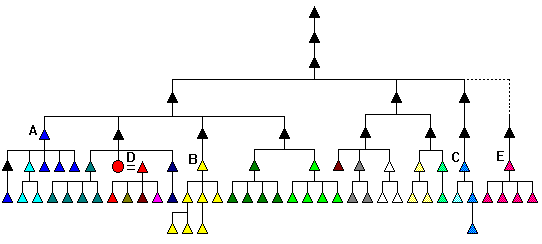
The above diagram shows the genealogical relationship among males in lineage V, the largest lineage in Sakaltutan. The group originates seven generations back from its youngest children to a founding ancestor, although branching is not evident until the fourth generation down. The founder's single grandson had three sons, each of whom established a branch or lineage segment. These in turn are divided into a total of nine branches derived from the founder's great-great grandsons, one of whom (A) was still alive at the time of research. Within the subsequent generations, the segments constitute a total of 19 households. (V's households are coded in red on the village map.) Three of these (A,B,C) include three generations of patrilineally related males, constituting extended patrilocal families. Three others include childless married sons and daughters-in-law of the household head. The remainder contain simpler units of nuclear families, childless couples and single men. (See Turkish domestic units for further discussion of household organization.)
Two branches of lineage V are anomalous, as they are not linked to the core group by clearly delineated partilineal ties. The segment originating with household D is actually attached though a uterine link. The male household head married in from another village and, as such, had no agnatic kin in the village. He was therefore dependent upon his wife's lineage for family cooperation and his children looked to their mother's relatives for agnatic support. The same situation may have applied to household E in the past. In this case the uterine link has probably been forgotten. Over time this situation will be regularized through the invention of patrilineal descent links. Unilineally organized societies frequently bypass rigid descent rules and recast genealogical histories in this way to deal with exceptions and anomalous cases.
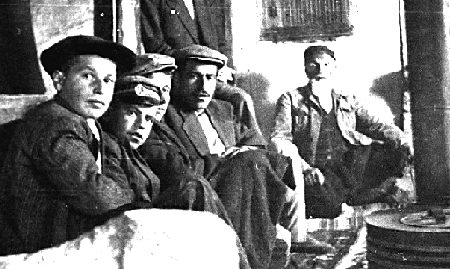
Consistent with their small size, Turkish peasant lineages have few effective functions. They do not own productive resources or other assets in common. Neither membership nor participation is automatically binding, and several households take no interest in lineage activities at all. As such, Turkish partilineal organization assumes the form of on occasional rather than corporate group structure. It provides an open social field, within which participants may choose to draw for aid and support. Nevertheless, patrilineages are prominent features of the village social landscape and form definitive foci of social interaction and political mobilization. Agnates are usually immediate neighbours and frequently visit and assist each other with domestic and agricultural tasks. Visiting is regularly organized in the guest rooms, which the more prominent village men maintain as major hubs of social activity. Agnates normally form the core of regulars who frequent these gatherings, especially in the winters, when outdoor activities are curtailed. (See Turkish Village page 238, for an extended discussion of guest room activity.)
Patrilineal ties, reinforced by neighborly contacts and guest room sessions, assume a more important function in the village disputes and feuds. While Turkish law and jural authority is officially endorsed in the villages, the actual legal process almost entirely left to informal leaders and customary local regulations. Since there is no firm central authority, many disputes go unresolved, and restitution remains in the hands of the aggrieved parties. Accordingly, villagers frequently take recourse to self help, vendetta, and feud, which can erupt in violence and sometime murder. In this less than perfect social order, lineages assume primary importance as sources of protection and armed support, and fellow agnates emerge as the only allies who can be firmly relied upon in a crisis. Conflicts between individuals therefore tend to be transposed to their lineage groups, which sometimes engage in long standing feuds as a result. (See Turkish Village, Chapter 11 for a fuller discussion of conflict and social control.)