Turkish Marriage Patterns
Marriage patterns in rural Turkey are noticeably influenced by
endogamous preferences
within both villages and kinship groups.
Other important marriage rules and customs center on the requirement that
prospective husbands pay a substantial
bride price
to their fathers-in-law.
The financial demands related to marriage tend to delay the marriage age of
poorer young men and to make it easier for older males to marry.
This practice is often related to polygyny,
the ability of a man to have more than one wife.
Polygyny is allowable in Islamic tradition but is prohibited in Turkish law.
Stirling observed only a small number of cases in the Turkish peasant
villages he studied.
Village Endogamy
Data from the two locations of Stirling's ethnography show a uniform
preference for marriage within the community as well as an interesting
contrast in rates of endogamy.
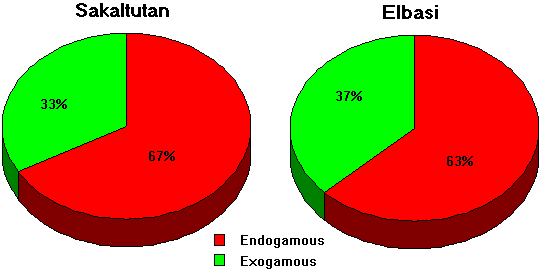
Both villages show a similar level of in-marriage among women currently
resident within the village, 67% for Sakaltutan and 63% for Elbasi,
indicating an approximate ratio of two women marrying and resident within
their natal village for every one who marries out.
Rates of Endogamy for Women Residing in
Village
Source: Turkish Village, pages
296-297
This outcome is a reflection of strong sense of solidarity within
the corporate peasant community, also apparent in the tendency for almost
every man to remain within his village over his lifetime.
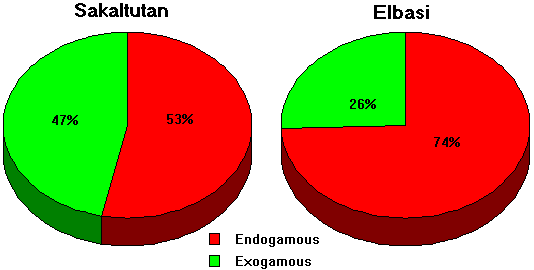
The contrast
in endogamous patterns appears in the differential out-marriage of women
born in each community as opposed to its resident women. Sakalutan women
show a low rate of remaining within their villages (just over 50%) and a
high propensity to marry men in other locations. The in-marriage rate for
Elbasi born women is considerably higher at almost 75%.
Rates of Endogamy for Women Born in Village
This discrepancy reflects an imbalance in female migration rates.
At the time of Stirling's research Sakaltutan experienced a net loss of
women, as the ratio of village out-marriage to in-marriage was 2:1.
Elbasi experienced a net gain resulting from the reverse situation.
These demographic peculiarities reveal a pattern of upward
marriage or hypergamy which is quite different from endogamy and
reflects an acknowledged status difference between communities. Elbasi is
the richer location and can draw upon wives from more marginal
settlements, from families who seek out more favourable domestic
conditions for their daughters as well as affinal contacts in prominent
communities. From another perspective, we can also conclude that the
village with the most resources is able to better actualize the cultural
ideal of endogamy.
Marriages among Kin
Additional preferences appear in marriages among coresident villagers and
show a marked tendency for marriage between close relatives.
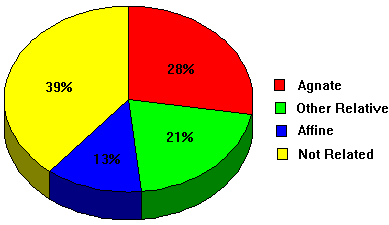
There is a clear pattern of lineage endogamy
generated by marriages between sons and daughters of brothers
and other agnatic kin, accounting for approximately a quarter of all marriages.
This is also known as
parallel cousin marriage and is
common in Middle Eastern societies.
As elsewhere, the advantage of lineage endogamy in Turkey is the
imposition of a bride price lower than those in contracts involving more
distant social bonds.
In-marriage also has the effect of retaining property within family lines,
especially where women are allowed to inherit.
Kinship Connections between Sakaltutan Husbands and Wives
>
Source: Turkish Village: page 202
Turkish village social patterns also show a marked preference for unions among
non-agnatic kin and current affines, and only a 40% incidence of marriage
between unrelated individuals.
(See Turkish Village
Chapter 9 for more details about marriage practices.)
© Brian Schwimmer, All rights reserved
Department of Anthropology
University of Manitoba
Page created 1995