|
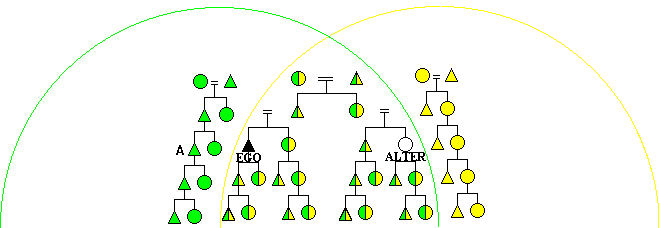
The salient feature of the kindred is that, no matter what its extent, it can never form a unique and exclusive group within a larger system. This limitation is a consequence of the fact that, since it is ego focused, each network of kin is associated solely with a particular individual. Thus Ego's kindred will be different from those of all of the relatives who are included in his group, except for his full brothers and sisters. For example, Ego's first cousin (Alter) is counted within his kindred but forms the focal point for the delineation of a separate unit. Both groups share some members, but each includes kin who do not belong to the other.
|
|
In this situation of overlapping membership, groups structure is relatively defined by specific individuals and contexts. Furthermore, no continuity over time is possible, since Ego's kindred ceases to exist after he and his siblings have died. (Ego's children become the focal point for a new kindred, which include their mother's kin, who are not in Ego's group.) Accordingly, kindreds cannot function as corporate groups with exclusive membership and rights in personnel and land. On the other hand, kindreds and other bilateral forms have advantages which lineal systems lack. Overlapping membership frequently provides a simple mechanism for forming alliances and reducing conflicts. Thus if Alter gets into a disagreement with an unrelated individual (A), Ego can serve as a intermediary to settle matters before a serious dispute occurs.
© Brian Schwimmer Members
of Ego's kindred
Members
of Ego's kindred  Members of Alter's kindred
 Individuals who belong to
both kindreds
Individuals who belong to
both kindreds