Cognatic Kinship in the Gilbert Islands
The Gilbert Islanders of the South Pacific have developed a complex
social organization based upon a system of nested bilateral and ambilineal
groupings. Ward Goodenough, has carried our a detailed study of their institutions
(Goodenough 1955), which provides clear examples of several
forms of cognatic
kinship. The salient groups identified include:
- the ooi,
a bilateral descent group, or
stock, which includes
all of the descendants of an common ancestor, and functions to assign inheritance
rights in land,
- the bwoti,
an ambilineal descent group, or ramage,
to which political authority is assigned,
- the kainga, a localized ramage, based on parental residence
choice.
The Ooi
The ooi is a
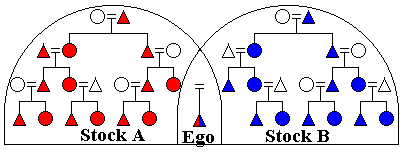
bilateral descent group composed of all of the
descendants of an recognized
ancestor traced through successive generations of sons and daughters, as
indicated in blue in the diagram below.
All of the members of an ooi inherit rights to some of the group's
land through mothers or fathers. The maternal share is usually small, since
men are awarded larger allocations than women. However, a woman's
holdings,
and consequently her children's inheritance, can be substantial if she has
no brothers. An ooi's membership is not exclusive, since
an individual will belong to as many stocks as he/she has recognized ancestors.
In the simplest case, a person will belong to and received rights
to land through his/her father's and mother's group, shaded in blue and
red,
respectively, in the diagram below.
In actual practice, a person can belong to anywhere from 4 to 16 ooi
traced to grandparents and more distance ancestors, depending upon the
genealogical record and the incidence of endogamy.
The Bwoti
The bwoti is political council which meets over important community
concerns. Membership is confined to males and is based on ownership of
designated plots within an ooi. It thereby constitues a subgroup
and, in fact, a segment of an ooi. Land rights involve only potential bwoti membership. An individual
has an option to join many groups in which he inherits privileges from
any of his ooi, but he can belong to only one necessitating a choice
among descent lines that is typical of the formation of an ambilineal descent
group, or ramage.
|
Potential Bwoti Memberships
|
|
|
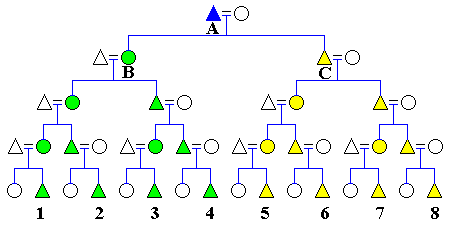
An ooi is subdivided into two bwoti according
to the division of A's land between B and C.
The people involved, shaded
in green and yellow, have the right to join the bwoti, but may not actually
assume membership. |
|
Actual Bwoti Memberships
|
|
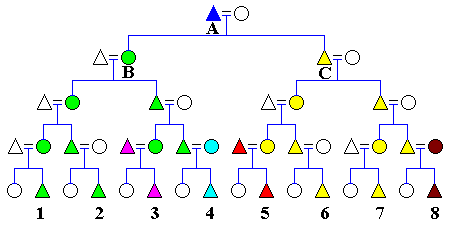
Eight individuals have sorted themselves out into
6 bwoti through the alternatives of belonging to their father's
group (cases 2,3,5,6) or their mother's (cases 1,4,7,8).
The situation
can be even more complicated since people can activitate claims based on
more remote ancestors and may switch membership. |
The Kainga
The kainga, as the bwoti, forms a ramage, but imposes
a more restrictive membership rule. It functions as a localized group established
at marriage. A couple decides whether to reside among the husband's or
wife's group and this choice determines their descent group membership.
Individuals living with their spouse family retain rights in their natal
kainga, but can not transfer them to their children.
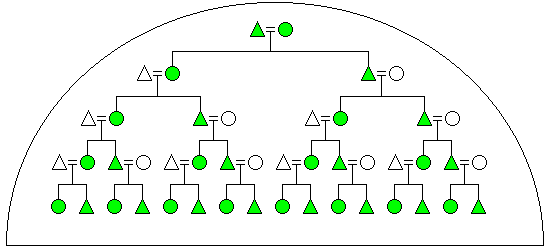
Both the kainga and the bwoti can be diagramed in the
same way, except for the inclusion of female members within the kainga.
Two people can potentially belong to the same bwoti and separate
kainga, but groups memberships do tend to be identical, since both
groups are tied to specific territories.
You have reach the end of the unit on descent systems.
Would you like to:
© Brian Schwimmer
University of Manitoba
Created: Sept. 1997
Last Updated: August 1998