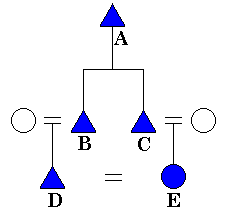
Parallel Cousin Marriage
|
|
This practice is usually associated with the need to maintain property within the family line and avoids dissipation of assets through affinal exchanges or female inheritance. Lineage endogamy is most frequently found in pastoral communities, in which the continuity of domestic herds forms a primary concern. It is also found as a common culture pattern in Middle Eastern societies including those of contemporary Arab communities and of ancient Israel.
The Bible offers an extensive demonstration of lineage endogamy among the generations of the Hebrew patriarchs. Isaac, Jacob, and Esau are purported to have married parallel cousins within their lineage and the text alludes to a half-sibling relationship between Abraham and Sarah. (See Genealogy of the Hebrew Patriarchs and Matriarchs). It also stresses the need for parallel cousin marriage to preserve the patrilineal inheritance of property in general situations in which a man has only daughters. If they marry their father's brother's sons, their family property can be transmitted to their son's and remain within the patrilineal group ( Numbers 36).
© Brian Schwimmer, All rights reserved