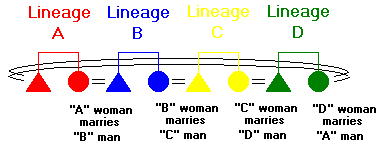
Marriages in Initial Generation
|
|
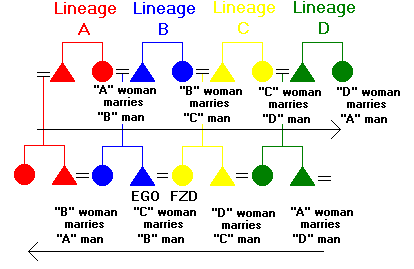
The actual patrilateral rule is applied in the next generation, specifying that a man must marry his father's sister's daughter, or patrilateral cross cousin. The marriage rule in this case creates a different pattern of exchanges than that of the previous generation; while women of the first cohort marry men from the right (A marries B, B marries C , etc), women of the next marry in the reverse direction (A marries D, B marries A, etc.)
Marriages in Second Generation
|
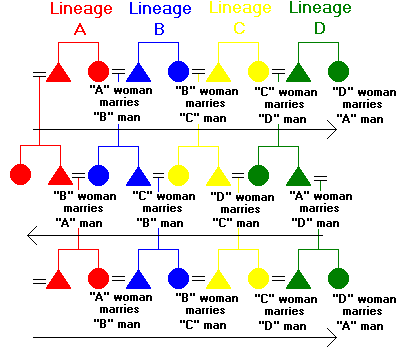
The application of the patrilateral rule in the third generation, reverses the circulation of women again, thus reiterating the pattern of the initial generation. Of course in the fourth generation the circulation would reverse again and assume the same form as in the second.
Marriages in Third Generation
|
The explanation of partilateral cross cousin marriage within alliance theory is a bit convoluted and focuses on two separate effects. Lineages are articulated into a circle as in the matrilateral case. However, the alternating exchanges that reverse the contacts between lineages in each generation link them as exchanging pairs. Group B gives a wife to C in the first generation, receives a wife from C in the second generation, gives a wife to C in the next, and so on. Thus a situation of direct exchange is present within a larger one of circular flows.
© Brian Schwimmer, All rights reserved